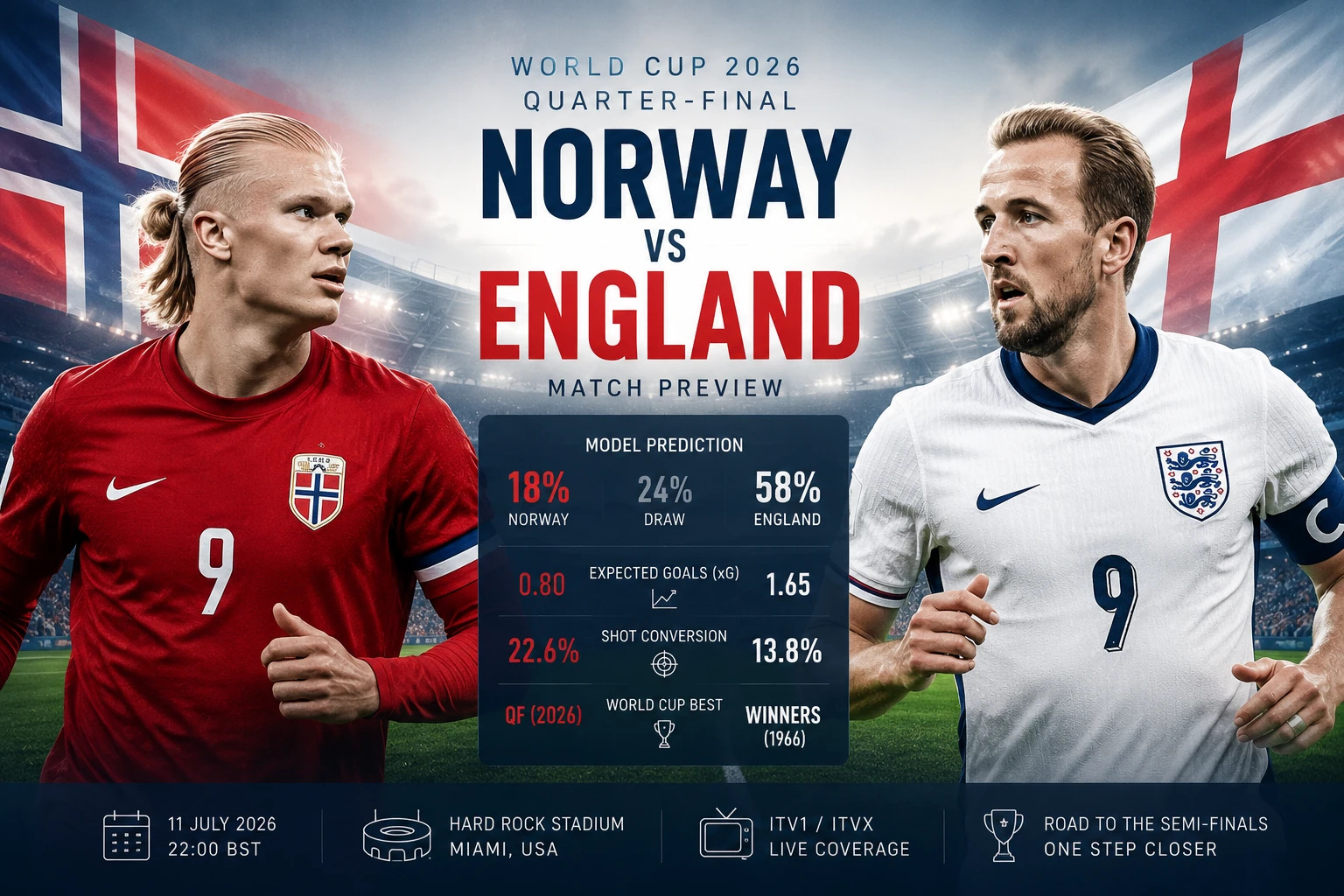
Norway and England meet at the Hard Rock Stadium in Miami on Saturday night with a place in the World Cup 2026 semi-finals at stake. It is a quarter-final few would have predicted before the tournament, but both sides arrive after dramatic last-16 victories and with their leading forwards in prolific form.
England edged past co-hosts Mexico 3–2 at the Estadio Azteca, surviving the second half with ten men after Jarell Quansah's dismissal. Norway produced the larger upset, beating Brazil 2–1 as Erling Haaland scored both goals to take his tournament total to seven.
The surface-level numbers make this look like a meeting of two high-scoring teams. Norway have scored 12 goals in five matches and England have scored 11. The way they have reached those totals, however, is very different. Norway have been one of the most clinical teams at the tournament, while England have generated considerably more shots and carry the stronger underlying team rating.
Our pre-tournament match model makes England the favourites, but Norway's results and finishing efficiency provide a clear warning against treating this as a straightforward quarter-final.
Norway vs England: Match Details
| Detail | Information |
|---|---|
| Competition | FIFA World Cup 2026 quarter-final |
| Date | Saturday 11 July 2026 |
| Kick-off | 10:00pm BST / 21:00 UTC |
| Venue | Hard Rock Stadium, Miami |
| UK TV | ITV1 |
| UK live stream | ITVX |
| Winner faces | Argentina or Switzerland |
For live match data, team pages and the tournament bracket, visit the World Cup 2026 section.
Norway vs England Prediction
England win probability in our pre-tournament match model, compared with 24% for the draw and 18% for Norway.
England's expected-goals projection, compared with 0.80 for Norway.
England's model rating, fifth-highest in the tournament field. Norway entered at 1501, ranked 25th by the same measure.
The model favours England by a meaningful but not overwhelming margin:
| Outcome | Model Probability |
|---|---|
| Norway win | 18% |
| Draw after 90 minutes | 24% |
| England win | 58% |
The projected expected-goals score is Norway 0.80–1.65 England, pointing towards an England victory by one or two goals. That forecast is based on the teams' pre-tournament strength rather than simply reacting to their five results in North America.
The distinction matters here. Norway have already outperformed their original tournament rating by eliminating Brazil, while England have largely delivered what their stronger baseline suggested they should. England remain the more complete side on paper, but Norway possess the tournament's most dangerous finisher and have repeatedly converted limited opportunities into goals.
Dedicated Betting prediction: Norway 1–2 England.
England are the more likely winners, but Norway's scoring record makes a comfortable victory difficult to support. Extra time remains a realistic possibility if England dominate the ball without creating clear chances or allow Norway to attack space around their full-backs.
The Key Statistical Matchup: Volume Against Conversion
The most important numbers in this quarter-final are not simply the goals scored. They are the shots required to score them.
| Tournament stat | Norway | England |
|---|---|---|
| Matches | 5 | 5 |
| Goals | 12 | 11 |
| Shots | 53 | 80 |
| Shots on target | 25 | 32 |
| Shot conversion | 22.6% | 13.8% |
| Shots-on-target conversion | 48.0% | 34.4% |
| Goals per match | 2.4 | 2.2 |
| Goals conceded per match | 1.8 | 1.0 |
Norway have scored one more goal despite taking 27 fewer shots. Their 22.6% shot conversion is among the highest at the tournament and considerably above the overall competition rate of 12.0%. Almost half of their shots on target have become goals.
England's 13.8% conversion is much closer to the tournament norm. They have created the larger volume, averaging 16 shots per match compared with Norway's 10.6, but have needed more attempts to produce almost the same attacking return.
That creates two possible interpretations.
First, England's output may be more repeatable. Teams can exert some control over how often they shoot, where those shots are taken and how much pressure they sustain. Extreme finishing rates are usually harder to maintain indefinitely.
Second, a knockout match does not require Norway's conversion rate to remain sustainable over months. It only needs Haaland and the supporting attack to punish one or two mistakes on Saturday night. Norway have already demonstrated that ability against Brazil.
England's task is therefore not merely to have more possession or more shots. It is to prevent Norway's smaller number of chances from becoming the highest-quality chances in the match.
Norway's Route to the Quarter-finals
Norway have won four of their five matches, scoring in every game and conceding in every game.
| Stage | Result |
|---|---|
| Group stage | Iraq 1–4 Norway |
| Group stage | Norway 3–2 Senegal |
| Group stage | Norway 1–4 France |
| Round of 32 | Ivory Coast 1–2 Norway |
| Round of 16 | Brazil 1–2 Norway |
Their five matches have averaged 4.2 total goals, with every game going over 2.5. Norway have scored 12 and conceded nine, making their matches among the most open of any remaining side.
The 4–1 defeat to France is the obvious negative result, although Norway rotated heavily after already securing qualification. Their first-choice side responded by edging Ivory Coast and then producing the result of their tournament against Brazil.
Norway's attacking numbers are concentrated around Haaland, but they are not entirely dependent on isolated individual moments. Martin Ødegaard and Andreas Schjelderup both have three assists, giving Norway multiple routes through which to supply their centre-forward.
The concern is defensive. Norway have not kept a clean sheet in five matches and have allowed nine goals. England have scored at least twice in four of their five tournament games, so Norway may need to score more than once again to advance.
Visit Norway's World Cup 2026 team page.
England's Route to the Quarter-finals
England are unbeaten at the tournament, with four wins and one draw.
| Stage | Result |
|---|---|
| Group stage | England 4–2 Croatia |
| Group stage | England 0–0 Ghana |
| Group stage | Panama 0–2 England |
| Round of 32 | England 2–1 DR Congo |
| Round of 16 | Mexico 2–3 England |
England have scored 11 goals and conceded five. Their defensive record is substantially better than Norway's, although four of those five goals conceded came in the two matches against Croatia and Mexico.
The last-16 victory was particularly revealing. England recorded only 33.2% possession against Mexico, their lowest share in a World Cup match in the available records, but remained dangerous on the counter-attack and found a way through a difficult game after going down to ten men.
That performance gives Thomas Tuchel another tactical option. England do not necessarily need to dominate possession to create chances through Jude Bellingham, Anthony Gordon, Bukayo Saka or Noni Madueke running beyond Harry Kane. Against a Norway side that has conceded in every match, transitions may offer England cleaner opportunities than slow attacks against an organised block.
Visit England's World Cup 2026 team page.
Haaland vs Kane
The quarter-final also brings together two of the tournament's three leading scorers.

 Manchester City · Norway
Haaland has scored seven of Norway's 12 tournament goals and converted 39% of his attempts, the best rate recorded by any player with at least 15 shots at this World Cup. His brace eliminated Brazil and showed the danger England face: Norway do not need sustained control if Haaland receives one accurate cross, through-ball or cutback in the penalty area.

 Bayern Munich · England
Kane has scored six of England's 11 goals and remains their primary penalty taker. His value extends beyond finishing: dropping away from the centre-backs can create running lanes for Bellingham and England's wide forwards. Norway's defence must decide whether to follow him into midfield or protect the space behind, a choice England are equipped to exploit either way.
Haaland and Kane have combined for 13 goals, accounting for more than half of all goals scored by their respective teams. It would be surprising if neither influenced the result directly.
The Midfield Battle
The individual focus will fall on the two centre-forwards, but the more decisive contest may take place behind them.
Martin Ødegaard is Norway's main creative link and has supplied three assists during the tournament. Sander Berge offers size and ball-carrying ability, while Patrick Berg provides protection in front of the defence. Norway's preferred shape can move between 4-2-3-1 and 4-3-3 depending on Ødegaard's starting position.
England are likely to pair Declan Rice with Elliot Anderson behind Bellingham. Anderson has been one of England's most consistent performers, while Bellingham enters after scoring twice against Mexico and now has four tournament goals.
England's numerical advantage in midfield could limit Norway's supply into Haaland. The risk comes when Rice or Anderson step forward and leave space for Ødegaard to receive between the lines. Norway do not need Ødegaard to dominate the game; one uncontested pass into Haaland's run may be enough to alter it.
Head-to-Head Record
England lead the recent historical series, but the two sides have not met for almost 12 years.
| Record from last 10 meetings | Total |
|---|---|
| Norway wins | 2 |
| Draws | 3 |
| England wins | 5 |
| Average goals | 2.5 per match |
The most recent meeting came in September 2014, when Wayne Rooney's penalty gave England a 1–0 friendly victory. England also won 1–0 in Oslo in 2012.
Norway's most famous result in the fixture remains the 2–1 World Cup qualifying victory in 1981, while their most recent win was the 2–0 qualifying success in 1993. The teams have never previously met at a World Cup finals.
The historical record offers context rather than a strong predictive signal. None of the last four meetings produced more than one goal, but the current Norway side is built around attacking talent of a level those previous teams did not possess, and its five tournament matches have produced 21 goals.
Team News
Norway
Norway's squad was affected by illness earlier in the week, but the latest information supplied ahead of the match indicates that the players have recovered. David Møller Wolfe has also returned to training after leaving the Brazil game late with a knock.
Julian Ryerson returned from a thigh problem to start against Brazil and is expected to retain his place. Ståle Solbakken could name an unchanged side, although Andreas Schjelderup and Oscar Bobb are pushing for starts after contributing from the bench.
England
Jarell Quansah is suspended after his red card against Mexico, making Djed Spence the likely replacement at right-back. Reece James has been managing a hamstring injury and remains a fitness question after missing recent matches.
Marc Guéhi and Declan Rice followed individual training programmes earlier in the week but are expected to be available. Jordan Henderson is reportedly out for the remainder of the tournament after suffering a wrist injury during the celebrations following England's last-16 victory.
Guéhi, Rice, Nico O'Reilly and Bellingham are all at risk of missing the semi-final if booked.
Predicted Lineups
Norway (4-2-3-1): Nyland; Ryerson, Ajer, Heggem, Wolfe; Berg, Berge; Sørloth, Ødegaard, Nusa; Haaland.
England (4-2-3-1): Pickford; Spence, Konsa, Guéhi, O'Reilly; Anderson, Rice; Saka, Bellingham, Gordon; Kane.
England have alternatives on the right wing, where Noni Madueke could replace Saka, while Norway may bring Schjelderup into the starting side after his two assists against Brazil.
Betting and Match Angles
The tournament numbers point in several directions, but they should not all be treated equally.
England to win
England's 58% model probability, stronger rating and superior defensive record make them the most likely winner. The model price is not strong enough to describe the match as one-sided, and Norway's recent results justify caution, but England remain the correct favourite.
Both teams to score
Norway have scored and conceded in all five games. England have scored in four of five and conceded in three. The attacking quality on both sides supports both teams scoring, although the case rests more heavily on Norway's open tournament profile than England's.
Over 2.5 goals
All five Norway matches have produced at least three goals. Three of England's five have also gone over 2.5. The combined match average across the two teams is 3.7 goals, but knockout football and England's stronger defensive structure may suppress the game compared with Norway's earlier fixtures.
Haaland or Kane to score
The two strikers have scored 13 of the teams' combined 23 goals. Both are central to their national attacks and both take penalties. The prices matter, but the statistical case for concentrating goalscorer interest on the two centre-forwards is stronger than spreading it across secondary attackers.
Final Verdict
Norway have earned their place in the quarter-finals rather than merely benefited from the draw. Four wins, 12 goals and the elimination of Brazil make them a credible threat, while Haaland's seven goals give them the most dangerous individual finisher left on this side of the bracket.
England nevertheless hold the stronger overall profile. They entered the tournament rated fifth by our model compared with Norway in 25th, have taken 27 more shots across five games and have conceded four fewer goals. Their 58% win probability and 1.65–0.80 expected-goals advantage capture that broader superiority.
The decisive question is whether England can convert control and shot volume into enough clear chances before Norway's efficiency creates a defining moment at the other end. Norway's 22.6% conversion rate may be difficult to sustain, but with Haaland leading the attack, England cannot assume it will regress during these 90 minutes.
Model Prediction: Norway 1–2 England. England to progress, but in a match likely to remain competitive deep into the second half.
Model probabilities are estimates based on pre-tournament team ratings and are provided as match context, not a guarantee of the result. Team news can change before kick-off.
Related articles
World Cup 2026 Golden Boot Odds
Harry Kane at 13/2 - our full analysis of the top goalscorer market using team progression probabilities, club form and penalty duties: World Cup 2026 Golden Boot Odds.
World Cup 2026 Group Predictions
Every group broken down by qualification probability and the teams the market has mispriced: World Cup 2026 Group Predictions.
World Cup 2026 Predictions
Our model rates all 48 teams and simulates the full bracket. Spain lead at 21.2%, but the most interesting outputs are where the model and the market diverge: World Cup 2026 Predictions.